I did not leave tech to become a writer; I evolved
Growing up I had a singular dream of building software. For 30 years that is what I did. Now I am a science fiction writer with a first novel, called The Change, coming out on the 1st of October.
That looks like a major shift in career, but it isn’t. It is an evolution, and the logic of it is more ordinary than it sounds.
I became a technology entrepreneur when software was still something you installed from a floppy disk. Over the decades that followed I built companies, developed products, raised money, hired teams, won and lost customers, and cofounded Lucernex, where I was CEO until it was acquired by a large corporation. I am co-founder in three companies now that will, one day, hopefully follow that same path.
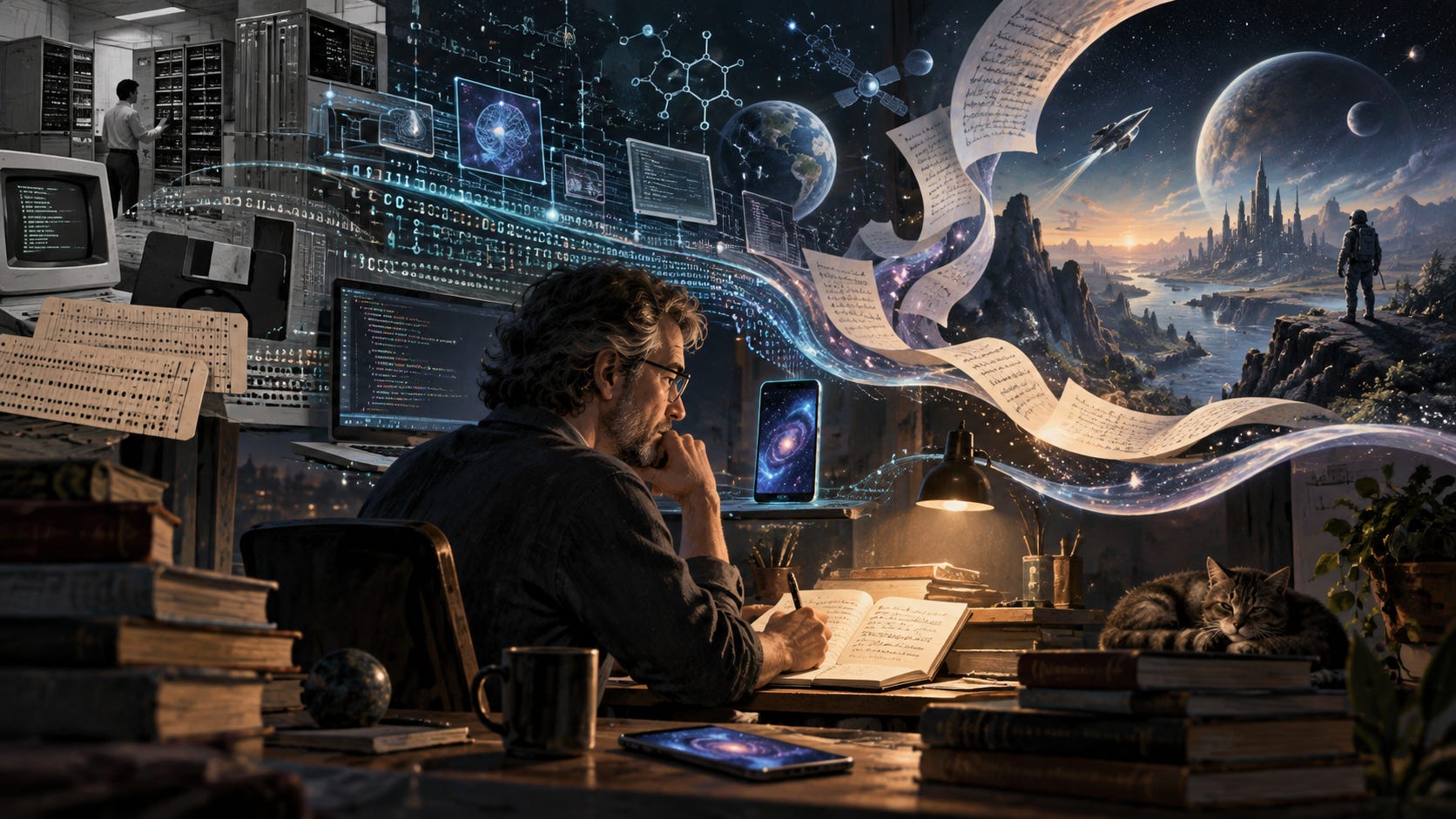
I have watched computing travel from punch cards fed into room-sized machines with memory measured in kilobytes to the phone I am writing this on, a machine millions of times more capable that fits in my hand.
Today I work inside the next transformation. I spend my days thinking about the moment AI stops being a tool that people use and starts acting on their behalf. And the questions get large very quickly. What happens to work. What happens to truth. Who controls it. What happens when a technology outruns anyone’s ability to govern it.
Those are business questions this quarter. They are also the questions that have driven science fiction for a century as in the famous Robot Series by Azimov.
Eventually I understood that some of the ideas I most wanted to chase were not a product roadmap. They were a story. So I went and wrote one.
Here is the part I did not expect, and it is the reason I am still doing it.
For 30 years every idea I had was governed by whether it could be built. Not whether it was interesting or important. Whether a team of a given size could ship it in a given quarter at a cost a customer would pay. That filter runs before anything else, and it is correct. A product that cannot be built is not an idea, it is a dream; and there are more of those in the tech world, including many that get funding, than most would know about.
But it is a brutal filter, and it does most of its damage early. You learn, after enough years, to filter out those ideas that may be truly interesting and meaningful, but are just not yet possible to bring to market. You stop before you start and often let that idea go forever.
Fiction removes that filter entirely. It removes exactly one constraint, feasibility, and it keeps the harder one, which is the vision forward.
Feasibility means taking the concept and making it real. Finding a way to often achieve something new, as most of my startups have been category definers, that may not have been done before. I have co-founded four companies; only one of which was based on my vision but I have hundreds of ideas I did not develop after running into a feasibility wall on often one element.
Now I do not have to stop; I can develop the ideas into stories instead of products that have to work!
A story about technology only works if the technology is honest. And that turns out to be the same discipline I have practiced my whole career, aimed at a different target.
I gave myself one rule when I started writing. If a real version of a thing exists, I do not get to invent it. I go find the actual science, learn it, and then bend the story to fit the facts instead of bending the facts to fit the story. I allow myself exactly one impossible thing, and everything standing around it has to be true; as that one impossible thing represents the feasibility gap.
So when my novel needed a drug delivered into a human brain to make the story work, I went looking for a way through the blood-brain barrier fully expecting to have to make one up. I did not have to. A physiologist worked it out at the NIH in the early 1970s using an ingredient found in most sugar-free candy, and there are patients alive now because of it.
When I needed a pollutant that could change a body, I found that one already existed. Tributyltin, used in ship paint, masculinized female marine snails at one part per trillion. That is one gram dispersed through a million metric tons of seawater.
When I needed a moment of insight that was not a lucky result in a laboratory, I found a recipe from the Amazon in which two plants that do nothing on their own become powerfully active together, and whose chemistry we can now describe down to the individual enzyme while remaining completely unable to explain how anyone discovered it.
None of that is decoration. It is engineering. It is the same work of establishing that a thing is possible before you build on top of it, and I enjoyed it more than I have enjoyed writing any product requirements documents in last twenty years.
The method has a name in my head now. Explain the ingredients, never explain the reaction. Research the real components until they are true, then let the one impossible, infeasible thing fly.
But the deepest thing I brought with me was not science at all. It was the business.
I have spent most of my career on subscription models. Recurring revenue, priced by the month, renewing forever. I have sold millions of dollars of annual subscriptions and firmly believe in its value as a business model.
But the reason I love the subscription model is not solely or even largely for the reason the bankers do. It is not the predictability of the revenue, though I do appreciate that. It is that the customer can leave. A subscription can be cancelled if the product stops being valuable. That means the product has to continue to stay current and remain innovative. If not, the customer cancels and value is lost for all. The risk of that loss drives continuous innovation, which is what keep me going and gives me a reason to spend budget on continuing to innovate even when the bankers want to just milk the cash cow.
The core of The Change explored this by making the monthly subscription not a software product to maintain company operations but a medication made to keep a dreadful illness at bay. And what if we took that to an extreme and put the horror of a global pandemic up against the greed of some people and businesses. What would win?
I could not have written that villain at 25. It took 30 years of sitting on the other side of that table to know exactly how reasonable he would sound.
The Change is not a novel about artificial intelligence, that will be in my next book series. It is a novel about a sickness, a river, an oligarchy and who gets to own a cure. The technology in it is biological, but real.
The idea sat in my head for a long time before I did anything about it, and once I started, the book took 3 years. Most of that was not writing. It was discovering the structure by walking into it and finding out where the walls were. I was building without a spec, which is a thing I would never have permitted a team of mine to do when building a product. I had to learn how to write a book at the same time as letting the vision for the story flow out of me.
And I learned. There is a series bible. There is a story map. There is a beat sheet that says what each chapter has to accomplish, which beats the series cannot survive losing, and what is forbidden to appear before a given chapter. It is its own type of spec with requirements, and features and version numbers. When something downstream stops working I can trace it back to the decision that caused it, the same way you walk a defect back through a release.
As I learned the steps and ingredients in writing a book, it started to look a lot like developing a piece of software - something I understood very well.
I resisted this for years, because there is a romantic idea that a story has to be discovered rather than designed. Having now done it both ways, I think that is half right. The vision and passion for the story have to be discovered. The architecture does not. And building the architecture first is precisely what buys you the time to go looking for the vision.
I have now designed an entire product to help me write books and it is allowing me to produce manuscripts much faster now. Which is why I believe I will have Remedy out by the middle of 2027 or sooner.
I do not think of myself as having left technology to become a writer. I brought the technology with me, and I left behind only the challenge of feasibility (not to mention fundraising).
After three decades of trying to predict the future in order to build a business, I have changed the question.
It used to be what should we build next.
Now it is what happens if we do.