The door into the brain
From the book The Change available for Pre-Order now.
Warning: this is a very sciency article based on actual Medical Science that I referenced in The Change available for Pre-Order Now.
There is a sentence in my novel that I wrote knowing it would likely be untrue.
A character finds a cure for a brain tumor and cannot deliver it, because the brain is walled off from the bloodstream. Searching for a way through, she remembers a technique from decades earlier. And the book tells you, plainly, that it had been abandoned; and 50 years from now it may be.
But as of today it has not been abandoned and shows no signs of going away.¹ I turned a working therapy into a forgotten one because my story needed a door that only a woman out of 2020 would remember, and had it still been in use, the story would not have worked.
Everything else in that passage is true, and the true version is even better than the one I semi-invented. And the science is fascinating.
Start with the problem, because most people would have no reason to know that the problem exists.
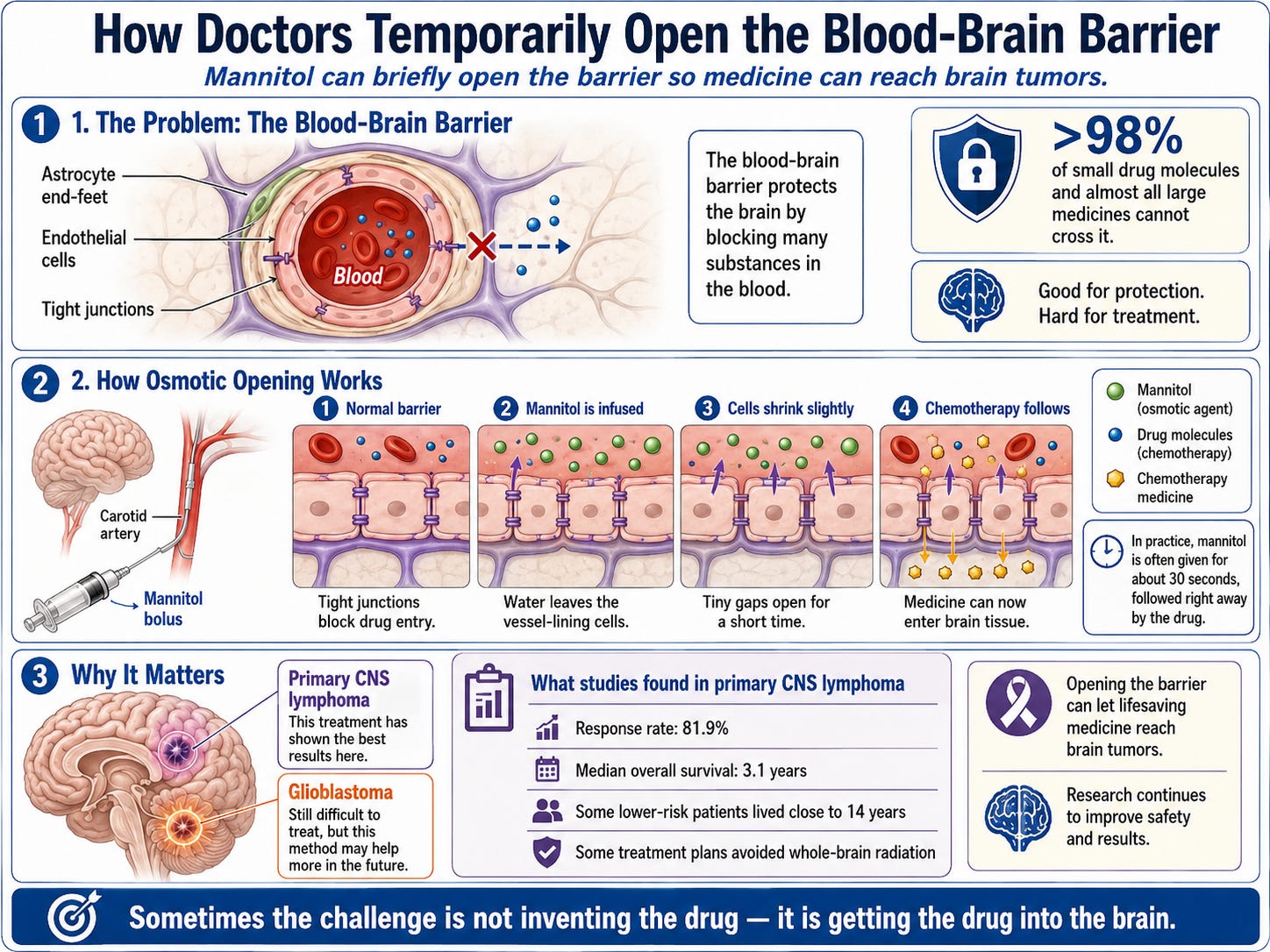
The brain is protected by a barrier that other organs do not have. The cells lining its blood vessels are stitched together so tightly that almost nothing crosses from the blood into the tissue. This is excellent engineering. It is why a bloodstream carrying whatever you ate, breathed or caught does not reach the one organ you cannot replace. It is called the blood-brain barrier.
It is also why so much of neurology and neuro-oncology is a story of frustration. William Pardridge, who has spent a career on this, put the figure bluntly in a 2005 review: the barrier excludes approximately 100 percent of large-molecule neurotherapeutics and more than 98 percent of all small-molecule drugs.² He did not say the far more innocuous “reduces the effectiveness of.” He said “excludes.”
When you read that a compound kills a certain cancer in the laboratory, and then read nothing more about it for a decade, this is very often the reason. The drug works. It simply cannot get to where the disease is. We are not always failing to invent the cure. Sometimes we have the cure and cannot open the door we need to introduce it.
In the early 1970s a physiologist at the National Institutes of Health named Stanley Rapoport worked out how to inch open the door for a limited time.³
The idea has the kind of simplicity that sounds like a trick. Infuse a concentrated sugar solution into the artery feeding the brain. The cells lining the vessels lose water by osmosis, shrink slightly, and as they shrink the tight junctions between them pull apart. The wall does not break. It creates gaps. And for a while, what is in the blood can cross over.
The sugar used is mannitol and you have all likely had it before. It is not exotic and it is not expensive. It is the sweetener in sugar-free candy and in some other low sugar foods.
Rapoport’s early results were not encouraging enough to use on people; his 1972 paper concluded that brain damage precluded it, in his words, at this time.⁴ Within a year he had found a way around it.⁵ And in 1979 a young neurosurgeon named Edward Neuwelt published the first of this work alongside Rapoport, with the first human series following in 1980.⁶ He then spent the better part of five decades on it, most of them at Oregon Health & Science University and the Portland VA.
The modern protocol is a 30-second bolus of warmed 25 percent mannitol into the carotid or vertebral artery, with the chemotherapy following minutes later, while the barrier is still open.⁷
In Chapter 12 of The Change, I write of a doctor who had been in suspended animation awaiting a cure for her disease and is brought back into a patriarchal oligarchy only because a very wealthy man has a rare brain cancer, science has long been banned and only this doctor from an age of science has a chance at curing it. The world she arrives in has no respect for science or women, so she is given one chance to cure this previously uncured version of brain cancer (glioblastoma) and I needed to find a believable way to make that happen. This real therapy has actually had very limited success against that cancer,⁸ but with fifty more years of medicine behind it, I thought it was a reasonable stretch.
The real status of the science is this.
The technique’s best results are in primary central nervous system lymphoma, a cancer of the brain with a grim history. The standard treatment was whole-brain radiation, which bought time and took cognition. Patients survived and were not entirely themselves afterward.
In 2009 a team led by Lilyana Angelov published the largest dataset in the Journal of Clinical Oncology: 149 newly diagnosed patients across 4 institutions, treated with barrier disruption and chemotherapy delivered straight into the artery, and no upfront whole-brain radiation. Response rate 81.9 percent. Median overall survival 3.1 years across the whole group, with a quarter still alive at 8.5 years.⁹
And in the low-risk patients, the younger ones who were still functional at diagnosis, median overall survival was approximately 14 years, with the curve flattening after about 8.⁹
Fourteen years, in a disease measured in months, without irradiating the brain. Neuwelt’s own earlier series had already seen early evidence of it in 1991: patients treated this way first lived a median 44.5 months against 17.8 months for those irradiated first, and cognitive function was preserved in six of seven of the non-irradiated complete responders.¹⁰
They kept their years. They also kept their minds.
So why have few people heard of this, and why was my invented sentence so easy to believe?
Here is where I have to be fair, because the tempting story is a conspiracy and the true story is duller and more important.
It is not suppressed. It is not forgotten. There were 4,939 of these procedures at OHSU alone between 1997 and 2018, with major complications in only 0.79 percent.⁷
It never became standard care for a mundane reason. It is not a pill or a shot in your doctor’s office. It requires general anesthesia, a specialized neuroradiology suite, and a team that has done it enough times to do it safely. There has been a slow uptake, partly out of concern that the technique is difficult to implement across centers.¹¹ And the results are not uniform. In lymphoma they are extraordinary. In glioblastoma they are modest, and seizures are common enough to matter.⁸ Newer approaches may prove to be more effective and are certainly easier to deliver.¹²
A therapy that works but cannot be delivered outside a handful of specialist centers is, for almost every patient on earth, indistinguishable from a therapy that does not exist. The medicine was never the constraint. The process of delivery was.
I wrote here recently about Manuel Elkin Patarroyo, who gave away a malaria vaccine patent rather than sell it, and whose vaccine then failed. I did not expect to arrive at the same place from the opposite direction so quickly.
That was a story about a cure that could have been owned and was not. This is a story about a cure that nobody owns, that nobody is hiding, and that still does not reach most of the people it could help. Between those two essays is the thing I have come to believe: we as a people are better at discovering than we are at delivering.
That gap is one of the core subjects of my novel, underneath the science fiction. A cure exists. Getting it into a human being is a separate problem, with its own politics, and the second problem is the one that decides who lives.
The Change is out on October 1 but available for Pre-Order Now.
Dr. Edward A. Neuwelt died on February 10, 2026, at the age of 77, while I was writing the chapter that uses his work in fiction.¹³
I did not know until afterward. He spent close to fifty years on a single stubborn question, published several hundred papers, and also worked on keeping children from going deaf from their own chemotherapy, which is the sort of thing that does not make anyone famous.¹⁴
He found a door in a wall that was not supposed to have one. Then he spent the rest of his life trying to get the rest of medicine to walk through it.
I do not think that is a tragedy. But it is worth asking, the next time you read that a cure has been found, a question that sounds cynical and is not: found by whom, available where, and to whom exactly? Those are four different questions. We have a habit of hearing only the first.
References
ClinicalTrials.gov identifiers NCT02861898, NCT02800486 and NCT01269853, all recruiting, records updated 2026. See also Reyes JS, et al. Therapeutic modulation of the blood-brain barrier in brain tumors: a systematic review. Cancer Chemother Pharmacol. 2026;96(1):35.
Pardridge WM. The blood-brain barrier: bottleneck in brain drug development. NeuroRx. 2005;2(1):3–14. PMID 15717053.
Rapoport SI, Hori M, Klatzo I. Testing of a hypothesis for osmotic opening of the blood-brain barrier. Am J Physiol. 1972;223(2):323–331. PMID 5046750. See also Rapoport SI, Hori M, Klatzo I. Reversible osmotic opening of the blood-brain barrier. Science. 1971;173(4001):1026–1028.
Rapoport SI, Bachman DS, Thompson HK. Chronic effects of osmotic opening of the blood-brain barrier in the monkey. Science. 1972;176(4040):1243–1245. PMID 4624461.
Rapoport SI, Thompson HK. Osmotic opening of the blood-brain barrier in the monkey without associated neurological deficits. Science. 1973;180(4089):971. PMID 4196324.
Neuwelt EA, Frenkel EP, Diehl JT, et al. Osmotic blood-brain barrier disruption: a new means of increasing chemotherapeutic agent delivery. Trans Am Neurol Assoc. 1979;104:256–260. PMID 121949. First human series: Neuwelt EA, Frenkel EP, Diehl J, Vu LH, Rapoport S, Hill S. Reversible osmotic blood-brain barrier disruption in humans: implications for the chemotherapy of malignant brain tumors. Neurosurgery. 1980;7(1):44–52. PMID 6251399.
Uluc K, Ambady P, McIntyre MK, et al. Safety of intra-arterial chemotherapy with or without osmotic blood-brain barrier disruption for the treatment of patients with brain tumors. Neurooncol Adv. 2022;4(1):vdac104. doi:10.1093/noajnl/vdac104. PMID 35892048.
Ferreira C, et al. Safety and efficacy of selective and superselective intra-arterial cerebral infusion with blood-brain barrier disruption for glioma: a systematic review and meta-analysis. J Neurointerv Surg. 2026;18(5):1337–1346. See also Dufault ME, Akhavan-Sigari A, Pachón-Londoño MJ, et al. From barrier to bridge: a scoping review on the methods, clinical efficacy, and safety of blood-brain barrier disruption in treating high-grade glioma. J Neurooncol. 2026;177(2):86. PMID 41922786.
Angelov L, Doolittle ND, Kraemer DF, et al. Blood-brain barrier disruption and intra-arterial methotrexate-based therapy for newly diagnosed primary CNS lymphoma: a multi-institutional experience. J Clin Oncol. 2009;27(21):3503–3509. PMID 19451444.
Neuwelt EA, Goldman DL, Dahlborg SA, et al. Primary CNS lymphoma treated with osmotic blood-brain barrier disruption: prolonged survival and preservation of cognitive function. J Clin Oncol. 1991;9(9):1580–1590. PMID 1875220.
Kuitunen HK, Rönkä ALK, Sonkajärvi EM, et al. Blood-Brain Barrier Disruption (BBBD)-Based Immunochemotherapy for Primary Central Nervous System Lymphoma (PCNSL), Early Results of a Phase II Study. Cancers (Basel). 2023;15(4):1341. PMID 36831682.
Woodworth GF, et al. Microbubble-enhanced transcranial focused ultrasound with temozolomide for patients with high-grade glioma (BT008NA): a multicentre, open-label, phase 1/2 trial. Lancet Oncol. 2025;26(12):1651–1664. PMID 41308679.
International Brain Barriers Society. In memoriam Professor Edward A. Neuwelt. https://www.ibbsoc.org/news/in-memoriam-professor-edward-a-neuwelt (accessed 2026).
Neuwelt EA, et al. First evidence of otoprotection against carboplatin-induced hearing loss with a two-compartment system in patients with central nervous system malignancy using sodium thiosulfate. J Pharmacol Exp Ther. 1998;286(1):77–84. PMID 9655844. See also Brock PR, et al. Sodium thiosulfate for protection from cisplatin-induced hearing loss. N Engl J Med. 2018;378(25):2376–2385 (Neuwelt EA, senior author). PMID 29924955.